In the world of modern commerce, every shipment represents a responsibility for companies, starting with the supply chain and extending through ports, roads, and warehouses until it reaches the end customer on time.
However, between the beginning and the end, there are many gaps, such as incomplete documents, customs delays, or partners who lack a complete view of the supply chain. These gaps can cost a company customers.
This is where end-to-end logistics management is the ideal solution, because it not only transports goods but also connects every point along the journey with threads of efficiency, transparency, and smart coordination.
What Is End to End Supply Chain?
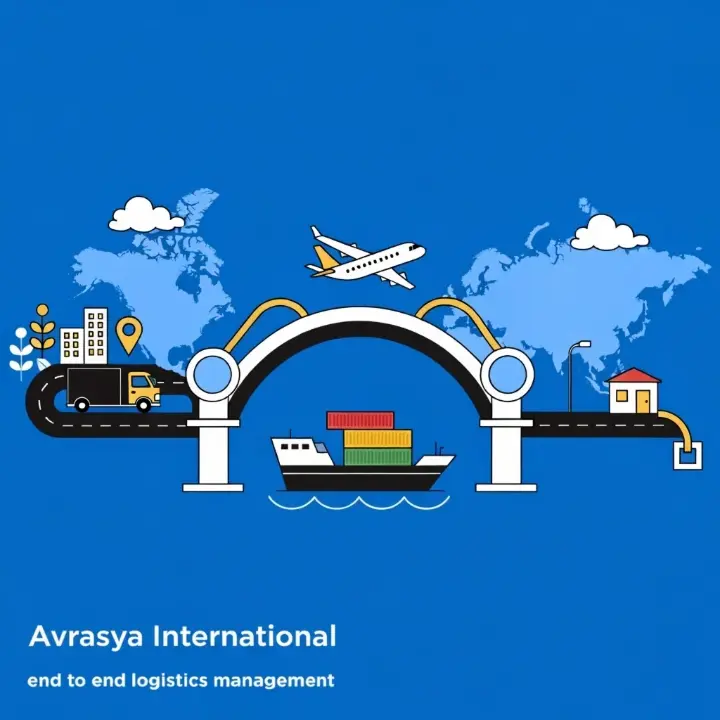
Supply isn't just about transportation. It's an interconnected chain that begins with the supplier and ends with the consumer, with each link interdependent.
But in most companies, each stage is managed separately, which creates chaos.
In an end-to-end supply chain, all stages are part of a single, integrated system that includes:
- Procurement: Purchasing materials from appropriate sources.
- Production: Managing the manufacturing or assembly process.
- Warehouse: Smart, traceable storage.
- Transportation: Shipping by land, sea, or air.
- Delivery: Delivering at the right time and place.
The result of end-to-end logistics management is an integrated supply chain that can be monitored, problems can be predicted before they occur, and costs can be controlled in real time.
Why End-to-End Logistics Management Matters?
Imagine a company importing electronic components from Turkey for assembly in Europe. Any delay at customs or any document error could halt production entirely.
But when you have end-to-end supply chain visibility, you can see the entire chain on a single screen, from real-time shipment status to transportation costs to supplier performance.
This helps companies:
- Reduce time and cost waste.
- Improve communication between suppliers and customers.
- Build a transparent and flexible supply network.
For companies operating across borders, this isn't a luxury; it's a survival necessity for the company to continue without losing any of its customers.
Key Benefits of End-to-End Supply Chain Management
End-to-end supply chain management isn't just about optimizing transportation processes; it's a strategic investment that transforms the entire way businesses operate.
By integrating all stages into a single, integrated system, companies can achieve tangible results, such as:
- ✓ Reduced operational costs: When data is unified and stages are interconnected, errors, unexpected costs, and time are reduced.
- ✓ Improved delivery efficiency and speed: Because each step in the chain communicates with the next in real time, shipments move smoothly without disruption or delay.
- ✓ Increased transparency and complete control: Real-time visibility into every process, from order to delivery, enables faster and more accurate decision-making.
- ✓ Enhanced customer and partner satisfaction: On-time delivery and a seamless experience build long-term trust between suppliers and customers.
- ✓ Enabling growth and global expansion: E2E supply chain management opens up opportunities for companies to confidently enter new markets by simplifying customs, documentation, and regional differences.
End-to-end logistics management is not just a "tactic" for improving operations but a growth strategy that ensures business sustainability and competitiveness in international markets.
End to End Supply Chain Planning
Every successful journey begins with a clear plan. In the world of logistics, planning isn't just about determining shipping dates or delivery points; it's the foundation upon which everything else is built.
Integrated planning begins with understanding market demand, analyzing supplier capabilities, and determining the best transportation methods to ensure a balance between speed and cost.
Planning is the step you need to implement end-to-end logistics management and maximize the benefits of the E2E supply chain.
Companies that use intelligent planning, such as modern E2E systems, can anticipate challenges before they occur, whether inventory shortages or customs delays. This gives them enough time to act quickly and minimize losses.
Planning helps a company find end-to-end supply chain solutions, because during planning, you know your company's strengths and weaknesses.
Strategic Supply Chain Management
After the plan is defined, the broader vision and the strategy come into play. Strategy links the company's broader goals (such as expansion or sustainability) to its day-to-day shipping and distribution decisions.
This is where questions like:
- Do we use multiple distribution centers?
- Should we ship by air or sea?
- How do we balance cost, speed, and quality?
Strategic management not only answers these questions but also transforms the supply chain from an operational function into a true growth tool.
This is precisely what distinguishes companies that work with strategic partners like avrasya. By partnering with avrasya, you can plan for the present but with a vision that extends to the future, thanks to its expertise.
How Is the Strategy Successful?
In the supply chain, no one can succeed alone. From suppliers to freight forwarders, from warehouse staff to sales teams, everyone must work as a single system. There must be end to end supply chain collaboration.
Collaboration here is not just communication between teams, but rather the integration of information and decisions.
When each party has a unified, up-to-date view of the status of the shipment or supply, decisions are made faster, errors are reduced, and costs are lowered.
This ensures that the end to end supply chain process is seamlessly integrated.
Continuous Optimization
Even the best plans need constant refinement. After developing plans and strategies, you must monitor them and ensure they remain effective.
Continuous improvement maintains supply chain efficiency in the face of changes, whether in prices, demand, or customs regulations.
Using data and analysis, companies can identify where time or money is being wasted and begin working to fix them step by step.
End to end supply chain optimization is the fuel that keeps the supply chain flexible and evolving at all times.
Companies that adopt an approach of planning, strategy, collaboration, and improvement not only manage successful supply chains but also build logistics systems capable of growing and adapting regardless of changing circumstances. This is made easier and faster when companies partner with logistics experts, and with avrasya, they can achieve an integrated supply chain end to end process.
F&Q
What Is the E2E Logistics Process?
The end-to-end logistics management journey can be summarized as five main stages:
- Planning & Forecasting: Data-driven planning to determine demand.
- Sourcing & Procurement: Selecting suppliers and signing contracts with clarity and compliance.
- Manufacturing & Inventory: Synchronized production and inventory control.
- Transportation & Customs: Accurate shipping and customs management without disruption.
- Delivery & Returns: On-time delivery and efficient returns management.
In an E2E system, each stage feeds data into the next, which makes the entire process flow seamlessly rather than being a series of separate points.
The Cross-Border Challenge
Companies involved in import and export, especially between the Balkans, Europe, and the Middle East, know that the challenge lies not in the transportation itself, but in everything surrounding it, such as:
- Different customs laws from country to country.
- Multiple document requirements.
- Delays due to a lack of coordination between intermediaries.
- High costs resulting from fragmented transportation between multiple companies.
This is where the value of a logistics partner emerges, one that can see the whole picture and not just move a shipment but manage it from the supplier to the customer.
How Avrasya Enables True End-to-End Supply Chain Management?
Avrasya doesn't treat shipping as a service but rather as an integrated journey from planning to delivery.
Through its extensive network in more than 20 active markets across many countries, particularly the Balkans, the Middle East, and Europe, Avrasya can connect suppliers and importers easily and quickly.
Our services cover all stages of E2E logistics:
- Procurement support
- Freight forwarding
- Intermodal transportation
- Customs clearance
- Warehouse & distribution
- Last-mile delivery
But what truly sets Avrasya apart is its technology and transparency, coupled with end to end logistics services.
At avrasya, we make every step of the journey trackable in real-time, and every report turns into a tool for better decision-making.
We're not just a transportation company but a strategic partner that transforms complexity into a seamless flow and the journey into a reliable experience.
From Complexity to Clarity: The Avrasya Advantage
avrasya relies on three core values in every logistics process:
- Simplify: Streamline processes, no matter how complex.
- Connect: Connect markets and suppliers through a robust regional network.
- Optimize: Optimize costs and time using intelligent data analysis.
This enables us to not only provide a service but also build a sustainable system for trade growth, whether you're expanding into the Balkans or exporting from the Middle East, or Europe.
Partnering for the Future of Trade
Ultimately, end-to-end logistics management isn't just a new trend; it's the only way to ensure your company remains competitive in a rapidly changing world.
By partnering with avrasya, you not only ensure seamless movement of goods but also clear visibility, calculated costs, and planned cross-border expansion.
Because success in trade isn't about the number of shipments you deliver but rather the integrated journey that gets you to your destination with confidence and sustainability.
Contact us to achieve an integrated supply chain